



 Market
The real shift in media isn’t reaction. It’s measurement
André Moreira
Markets have always reacted to headlines
What’s changing now isn’t the existence of that reaction, but the ability to measure it more explicitly, surface it more visibly, and integrate it more directly into how audiences consume information.
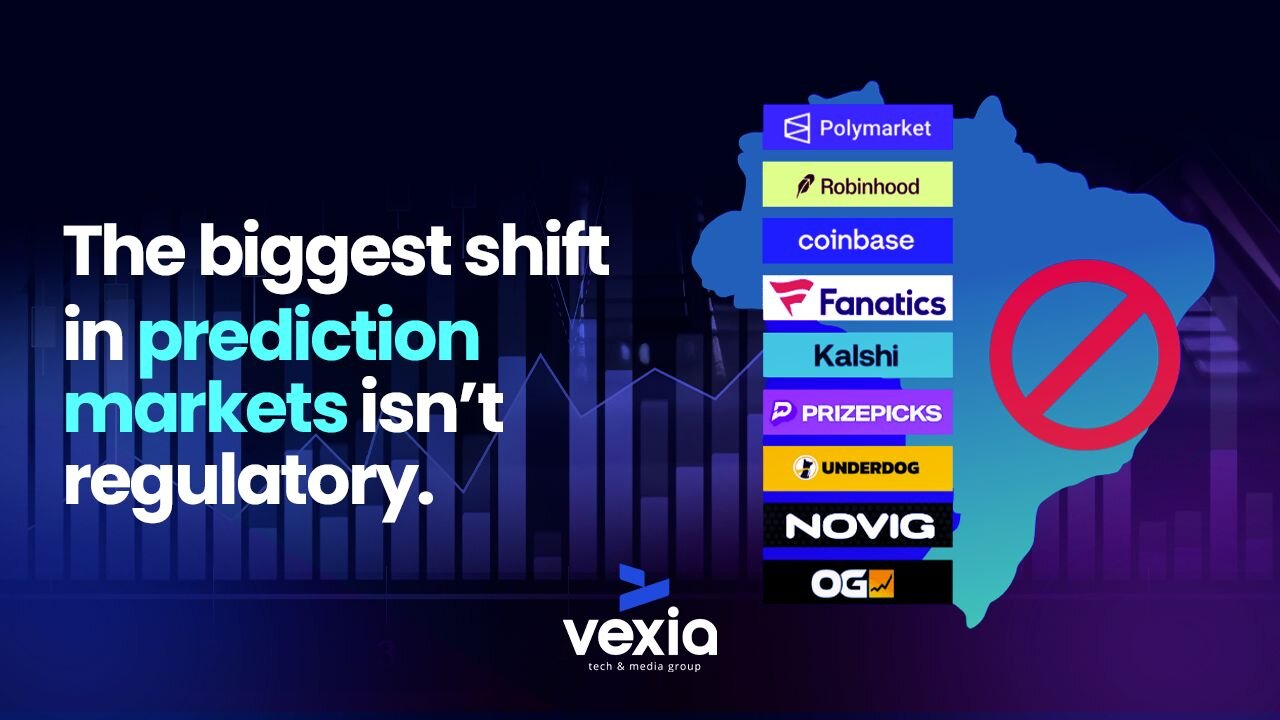
That’s what makes Kalshi’s growing presence across major US media environments worth paying attention to. The real significance isn’t the announcement itself, but the pattern behind it: prediction markets are starting to move closer to the editorial layer of mainstream media.
For those less familiar with the space, Kalshi is a US-regulated prediction market platform. In practice, it allows people to trade on the likelihood of future events, producing live market-based probabilities across politics, economics and public affairs.
Placed alongside Kalshi’s previously announced relationships with CNN and CNBC, the direction becomes clearer. This is no longer just a niche product story. It’s increasingly a media story.
That matters because what’s entering the newsroom isn’t just another stream of commentary. It’s a more explicit way of surfacing expectation, probability and perceived relevance in real time.
Of course, this doesn’t mean markets are infallible. It doesn’t mean editorial bias disappears. And it certainly doesn’t mean every event should be reduced to a tradable contract.
But it does signal something important: mainstream media is beginning to complement traditional reporting with a more visible layer of probabilistic interpretation and that’s a meaningful shift.
Markets always reacted. The difference now is visibility.
Markets reacting to headlines is nothing new. Newsrooms, commentators and analysts have always tried to interpret that signal.
Financial journalism has long relied on shorthand narratives to describe this dynamic — whether around elections, economic data, earnings reports or the appointment of a key minister. The familiar framing is always there: markets reacted positively, investors were spooked, traders welcomed the move.
What’s changing now isn’t the existence of market reaction, but the ability to surface it more explicitly, in real time, and with greater precision. That matters because it helps reduce overstatement and interpretative error.A reaction that once had to be narrated after the fact can now be tracked more directly through live probability, observable pricing behaviour and dynamic market signals. That doesn’t eliminate interpretation. But it does change the quality of the inputs behind it. In that sense, the shift isn’t reaction. It’s measurement.
The shift isn't the existence of market reaction, but the growing ability to measure, interpret and editorialise it in real time.
First, media is becoming more signal-driven
News organisations have always relied on polling, analyst commentary and expert interpretation to help audiences make sense of uncertainty.
Prediction markets add something different: a live, continuously updating signal based on what participants are willing to back in market terms.
In editorial terms, that creates a new class of content. Not just opinion, analysis or retrospective explanation, but scenario tracking, probability shifts and market reactions that can evolve in real time.
That’s important because it moves part of the information experience away from static interpretation and closer to measurable expectation.
The story is no longer only what happened. It’s also how the perceived likelihood of what happens next is changing in response.
Second, attention is moving from headlines to dynamic context
A headline tells you what happened. A market-based layer can tell you what the crowd now believes is more or less likely because of what happened.
That creates a different user experience. It adds motion to information. It gives audiences a live sense of consequence, not just a static account of events.
For publishers and platforms, that matters. Dynamic context can increase repeat visits, deepen engagement and encourage users to follow evolving scenarios rather than consume news as a sequence of disconnected updates.
This isn’t about replacing journalism with numbers. It’s about enriching the way uncertainty is framed and consumed.
And in a media environment shaped by constant updates, that kind of interpretative layer becomes strategically valuable.
Third, the boundary between media, finance and interactive products is thinning fast
Once prediction data is integrated directly into coverage, a media company is no longer just reporting on events. It’s also helping audiences navigate uncertainty through live market mechanisms.
That has implications far beyond editorial style.
It affects product design, because information becomes more interactive and state-based. It affects trust architecture, because audiences are no longer only receiving expert interpretation. They’re also seeing a live signal of collective expectation. And it affects monetisation and compliance, because the closer media gets to market-based products, the more carefully those boundaries need to be managed.
What makes this especially significant is FOX’s scale.
Few media groups can introduce a new interpretative layer to an audience of that size across both traditional news distribution and direct-to-consumer streaming. When a company operating at that level starts incorporating this kind of signal into the information experience, the effect isn’t marginal. It helps normalise a new editorial logic at mainstream scale. That’s when a niche mechanism starts becoming infrastructure.
Why Kalshi’s position matters
Kalshi’s role here is especially relevant because this isn’t being framed as an informal or offshore betting product.
The company operates under the oversight of the CFTC, the US federal regulator responsible for derivatives markets, and KalshiEX has been recognised as a Designated Contract Market. That distinction matters.
What’s entering the newsroom isn’t simply sentiment data, social chatter or a gamified widget layered on top of the news. It’s regulated, market-based probability. That doesn’t make it neutral. And it doesn’t make it automatically right.But it does make it structurally different from the kinds of speculative or entertainment-driven mechanics that many audiences might instinctively associate with event-based forecasting.
This is about more than one partnership
That’s why this shouldn’t be read only as a story about FOX, Kalshi or one distribution deal.
It’s a broader signal about where media may be heading. Prediction markets are moving closer to the centre of the information ecosystem. Not because they replace reporting, and not because they eliminate interpretation, but because they offer a new way to make expectation visible.
For executives across media, sports, fintech and regulated gaming, that’s the real takeaway.
The winners in this next phase won’t be the companies that simply place odds on a screen. They’ll be the ones that understand how to translate probability into trust, product value and better decision-making for audiences.
That’s the real opportunity. Not turning news into markets. But using measurable signals more intelligently inside the information experience. Because the future of media may not belong only to those who explain what just happened.
It may also belong to those who can help audiences understand what is becoming more likely next.
Share Article